
Audi Quattro, Sport Quattro and S1 E2
When Audi unveiled the Quattro at the Geneva Motor Show on 3 March 1980, many rally teams thought four-wheel drive was too heavy and too complex for the sport. Two years later Audi were manufacturers’ champions — and after 1983 no car without four-wheel drive ever won the makes’ title again.
Audi Quattro A2 (1983–1984) — indicative
Episode 4 — Short and Savage: Audi Sport quattro, S1 E2 & Audi’s European Titles
From a military vehicle in the snow to the short Sport quattro, the S1 E2 and Audi’s national titles across Europe.
An idea born in the snow
The story starts not with a rally team but with a test drive. In 1977 Audi chassis engineer Jörg Bensinger noticed that the Volkswagen Iltis, an off-roader built for the German army, was quicker in the snow than far more powerful passenger cars. Together with Walter Treser, head of pre-development, he worked up the idea of a fast road car with permanent four-wheel drive. Technical chief Ferdinand Piëch backed the project and saw rallying as the perfect stage. See also designers and engineers.
From Group 4 to Group B
In 1981 the Quattro ran in Group 4. Hannu Mikkola won as early as its second world rally (Sweden 1981), and Michèle Mouton made history in Sanremo. In the transition year of 1982 Audi won seven world rallies and the manufacturers’ championship.
For 1983 came the Group B versions: the A1 (debut at Monte Carlo 1983) and the A2, with lighter components and more power. Mikkola won the 1983 world title with it, Blomqvist the 1984 crown. Under Roland Gumpert, Audi Sport won four world titles in those years (manufacturers 1982 and 1984, drivers 1983 and 1984).
The car that taught rallying four-wheel drive: from the Quattro A1 and A2, via the short Sport Quattro, to the winged S1 E2.
Sport Quattro: shorter and faster
Against Peugeot’s compact mid-engined car, the long Quattro was too heavy and too cumbersome. Audi therefore built the Sport Quattro: a shortened version with a 20-valve five-cylinder (2,133 cc) and body panels of composite and Kevlar. Audi built 224 road cars, which cost more than 200,000 Deutschmarks in Germany. The rally version made its debut in Corsica in 1984, but the engine still sat far ahead of the front axle. Drivers complained of understeer and nervous handling. Blomqvist won with it in the Ivory Coast in 1984.
S1 E2: wings and anti-lag
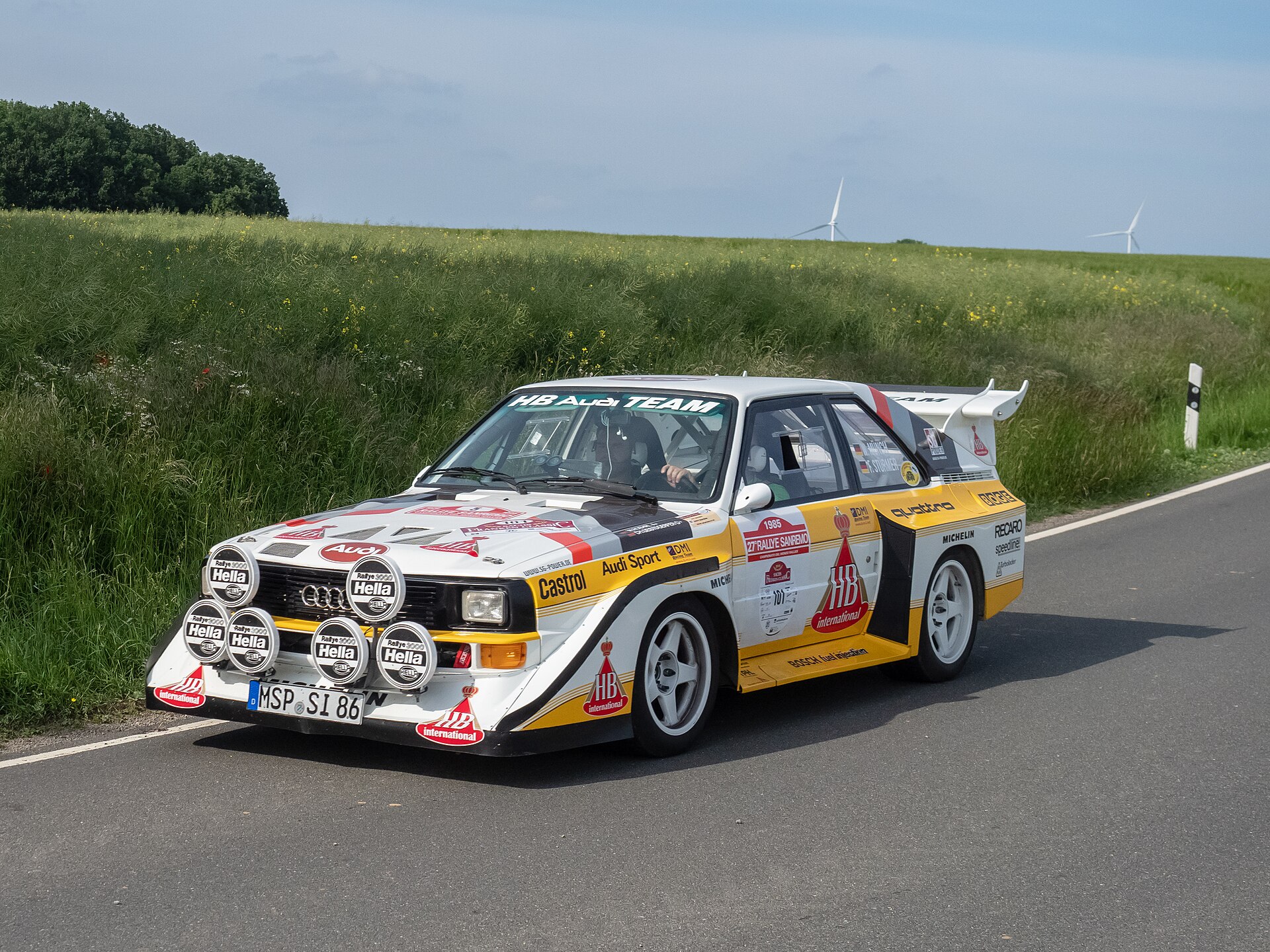
The Sport Quattro S1 E2 made its debut on the 1985 Rally Argentina, driven by Blomqvist. Its hallmarks were the large front splitter and an enormous rear wing, with the radiator moved to the back to improve weight distribution. The turbo used an air-recirculation system that kept it spinning when the driver lifted off or changed gear — an early form of anti-lag, and the reason for the S1’s famous bangs and pops. Sources quote power between roughly 470 and well over 500 hp; higher figures are poorly documented.
Walter Röhrl won the 1985 Rallye Sanremo with it: Audi’s last world championship win in Group B. In 1986 Mikkola was third in Monte Carlo, but after Portugal the works team did not start another world rally.
Key world championship results
- 1982: manufacturers’ champions; seven WRC wins (still as a Group 4 car)
- 1983: Mikkola world champion; five wins
- 1984: manufacturers’ and drivers’ titles (Blomqvist); seven wins
- 1985: one win (Röhrl, Sanremo); runners-up in the manufacturers’ standings
- 1986: third place in Monte Carlo (Mikkola); withdrawal
Drivers who won in the Quattro
Hannu Mikkola, Stig Blomqvist, Michèle Mouton and Walter Röhrl. Others who drove works or semi-works cars included Per Eklund, Lasse Lampi, Franz Wittmann, Bernard Darniche, John Buffum and Harald Demuth.
On the wheelbase. Audi describes the Sport Quattro’s wheelbase as more than 30 centimetres shorter than the standard Quattro’s; English Wikipedia gives a smaller difference. We follow Audi’s description, but the figure is not consistent across sources.
European and national championships
The Quattro won the German title in 1982 and 1984 (Harald Demuth), the British title in 1983 (Stig Blomqvist), the Austrian title from 1983 to 1985 (Franz Wittmann twice, Wilfried Wiedner) and every Finnish Group B class title from 1983 to 1986. See European and national championships.
Results in the World Rally Championship
World Rally Championship podiums of the car (all evolutions), year by year (1982–1986). win 2nd 3rd
20 WRC wins · 57 podium finishes, 1982–1986
Photo gallery 4 photos
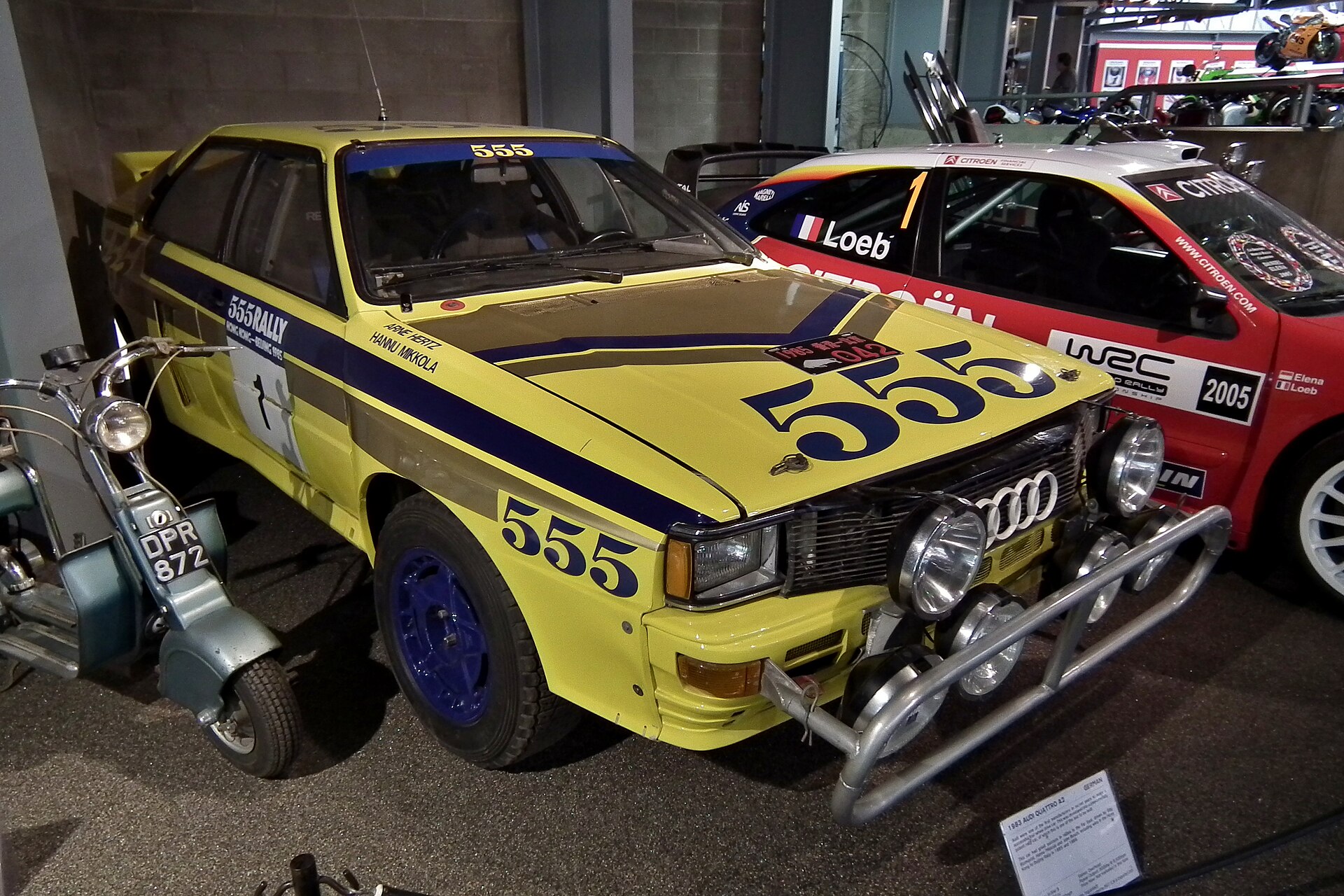
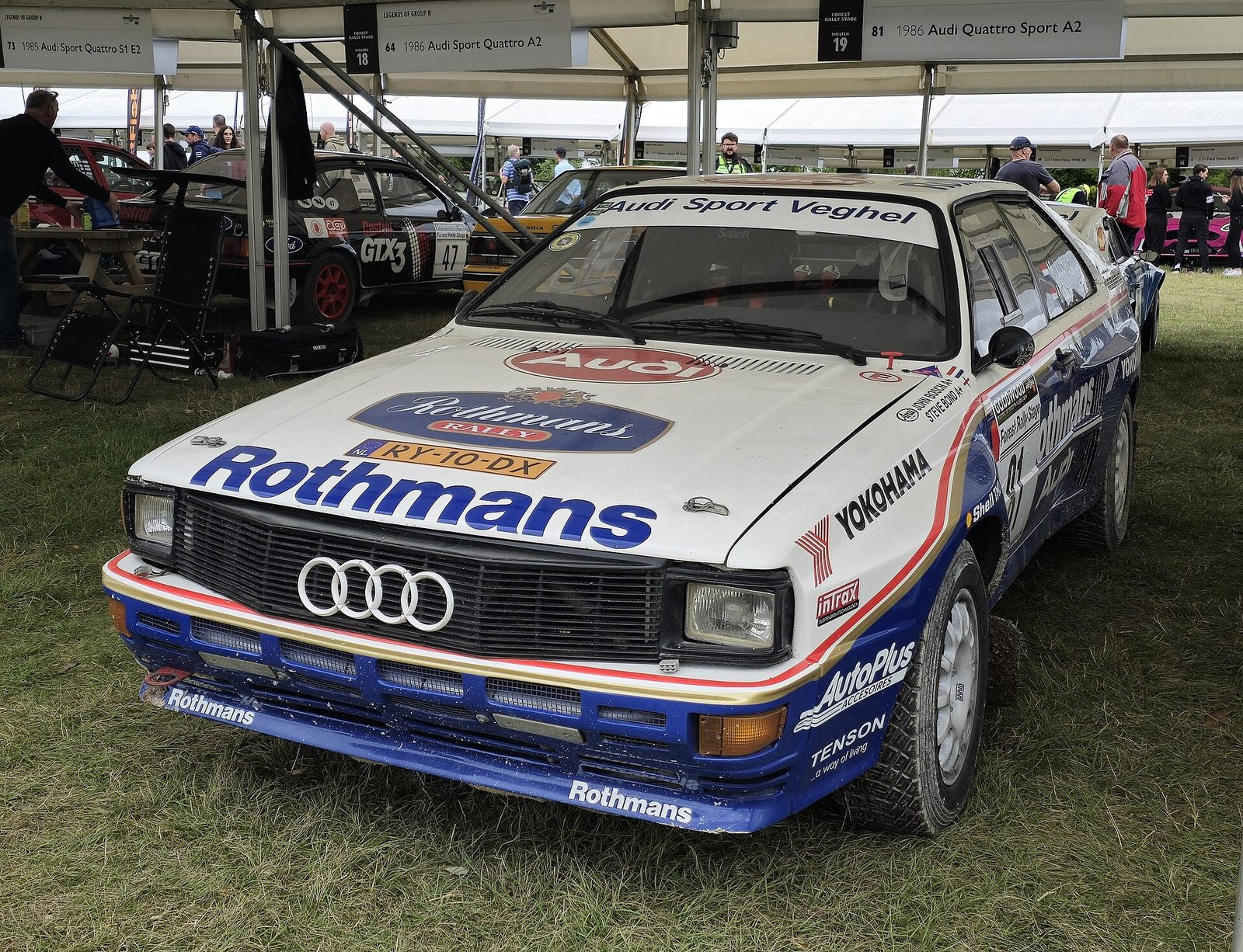
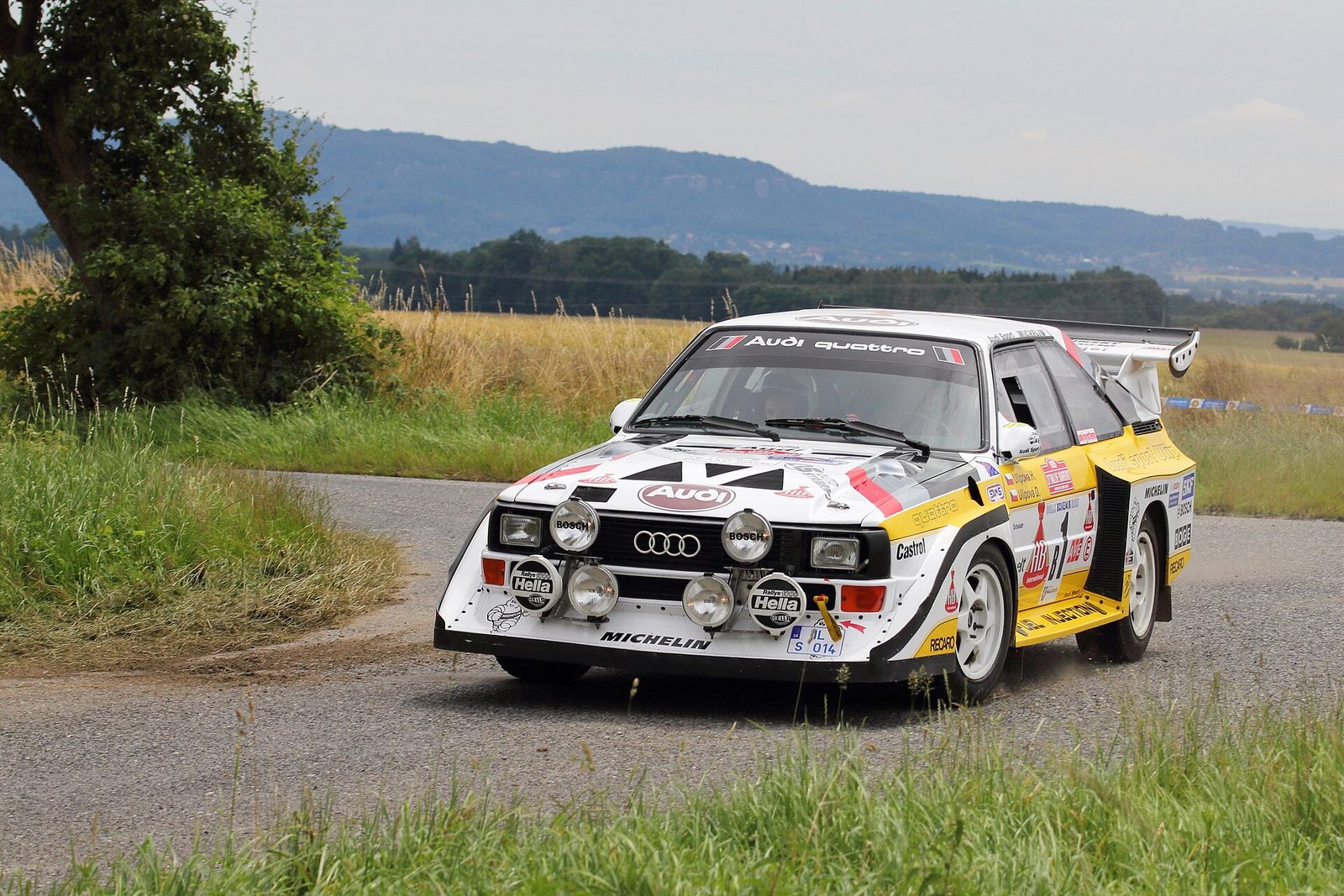
Historic Group B cars photographed at events, demonstrations and museums; each caption states where and when.

Further resources
- Motor Sport: Quattro S1 and E2 EN · article · subscription
The short-wheelbase Sport quattro and its winged E2 evolution. - FIA homologation: Audi Quattro A2 (form B-243) EN · archive
The FIA's homologation record with dates, extensions and the scanned form. - FIA homologation: Audi Sport Quattro S1 (form B-264) EN · archive
The FIA's homologation record with dates, extensions and the scanned form. - Audi Quattro: Group B, Sport, Sport S1 (Rally Giants) — Graham Robson (Veloce) EN · book
Compact history of the rally quattros from the Rally Giants series. ISBN 9781845841416. - Audi Quattro Rally Car Manual — Nick Garton (Haynes, 2019) EN · book
Technical "owners' workshop manual" treatment of the rally quattro. ISBN 9781785212505.
More from Cars
Sources
- Wikipedia (EN), Audi Quattro (incl. rally history, Sport Quattro, S1 E2) — https://en.wikipedia.org/wiki/Audi_Quattro
- Wikipedia (EN), Audi Quattro (including the Sport Quattro) — https://en.wikipedia.org/wiki/Audi_Quattro
- Wikipedia (EN), Roland Gumpert — https://en.wikipedia.org/wiki/Roland_Gumpert
- eWRC-results, results 1981–1986 — https://www.ewrc-results.com/
All text is original writing for Grouve Sports Management Group, based on the sources above. Facts checked on 21 October 2026.
Follow Grouve Sport on YouTube — rally Shorts now, Group B documentaries soon.
SubscribeThumbnail photos on this page: Miloslav Rejha (Wikimedia Commons, CC BY 4.0); Calreyn88 (Wikimedia Commons, CC BY-SA 4.0); _morgado (Wikimedia Commons, CC BY 2.0); Carlo Marzetti (Wikimedia Commons, CC BY 4.0); Thesupermat (Wikimedia Commons, CC BY-SA 4.0); TTTNIS (Wikimedia Commons, CC0).