
What was Group B? Rules, homologation and the end
How FISA reorganised motorsport in 1982, why 200 road cars were enough, how 'evolutions' worked and why the rules disappeared after 1986.
Group B was not born as a rally class but as a clean-up exercise. In 1982 FISA (the Fédération Internationale du Sport Automobile) rewrote Appendix J of the International Sporting Code: the old numbered Groups 1 to 5 were replaced by three new categories — Group N, Group A and Group B.
Episode 1 — Birth of a Monster: How Group B Began (1982)
How a technical reshuffle in 1982 led to 500-horsepower rally cars.
Three new groups
| Group | Intended for | Minimum production (12 months) |
|---|---|---|
| Group N | near-standard production cars (successor to Group 1) | 5,000 |
| Group A | modified production cars with four seats (successor to Group 2) | 5,000 |
| Group B | GT cars with at least two seats (successor to Groups 3, 4 and 5) | 200 |
Group B therefore replaced both the GT classes already used in rallying (Groups 3 and 4) and the silhouette cars of circuit racing (Group 5). It was meant for sports cars that did not fit Group A because they had too few seats or were built in too small numbers — think of a Porsche 911 or a Ferrari 308.
Homologation: 200 cars, then 20 ‘evolutions’
The heart of the story is a single number. Where Group 4 had demanded 400 cars, Group B needed just 200. Once a model was approved (homologated), a manufacturer could homologate an evolution by building only 20 examples — ten per cent of the base run. That evolution mechanism is what made Group B explosive: the 200 ‘road cars’ could be relatively tame, while the twenty evolutions were pure competition machines.
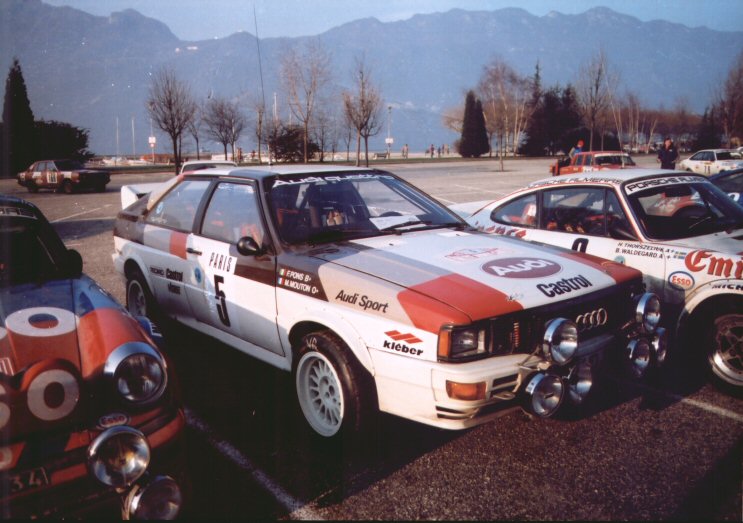
Manufacturers exploited it cleverly. Peugeot built 200 road versions of the 205 Turbo 16 and then homologated the far more radical 205 T16 E2. Audi did the same with the Sport Quattro and S1 E2. And because nothing in the rules banned a spaceframe chassis, a car like the Lancia Delta S4 could have a production model in the showroom while the rally car had nothing technically in common with it.
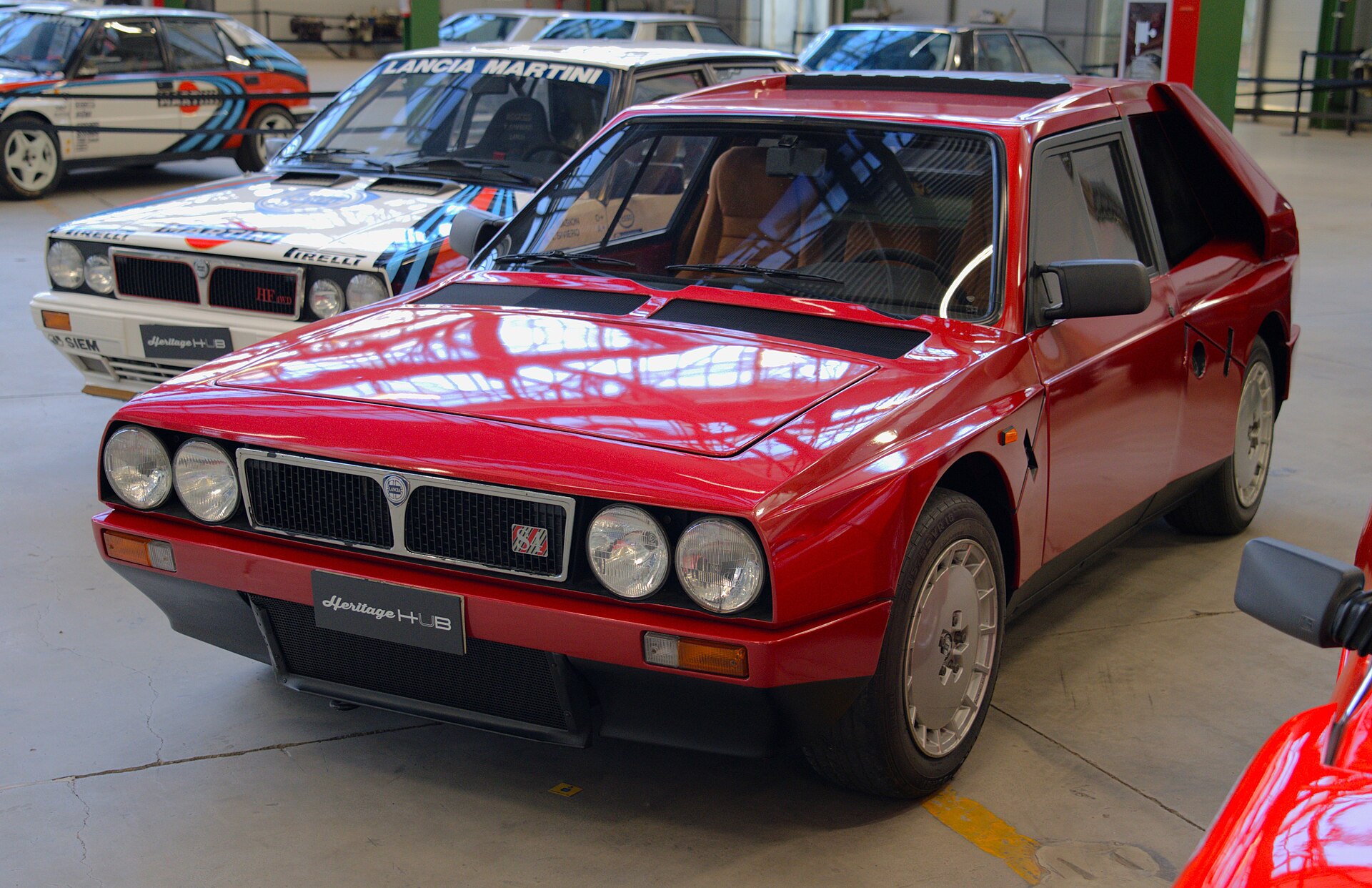
How many road cars were really built? For several models there are doubts whether all 200 had actually been produced when the inspectors came to count. For the Lancia Delta S4 Stradale, sources give a figure that may have been below 100. We do not repeat such claims as fact and mark them as uncertain.
Weight classes and the turbo factor
There was no power limit. FISA tried to contain speed through a minimum weight linked to engine capacity. Turbocharged and supercharged engines were multiplied by a factor of 1.4 (rotary engines had their own formula). The classes that mattered most in rallying:
| Class (corrected capacity) | Max. capacity with turbo | Minimum weight | Examples |
|---|---|---|---|
| up to 2,500 cc | approx. 1,785 cc | 890 kg | Peugeot 205 T16, Lancia Delta S4 |
| up to 3,000 cc | approx. 2,143 cc | 960 kg | Audi Quattro, Lancia 037 |
| up to 4,000 cc | approx. 2,857 cc | 1,100 kg | no front-line rally car |
This explains why Peugeot and Lancia chose engines of just under 1.8 litres: with a turbo they fell into the lighter 890 kg class, while Audi’s 2.1-litre five-cylinder tied it to 960 kg (and considerably more in practice). Because boost pressure was free, power climbed from around 250 hp in the winning cars of 1981 to well over 450 hp in 1986.
The transition from 1982
In the first year the old Group 2, 3 and 4 cars were still allowed to compete, and many existing models were carried over into Group B. That is why Walter Röhrl won the 1982 title in an Opel Ascona 400, and why Audi ran a Quattro that year that was technically still a Group 4 car. Only in 1983 did Group B truly become the premier class of the World Championship.
Why it went wrong
Three developments converged:
- Performance without a ceiling. Unlimited boost, lightweight materials (Kevlar, carbon fibre, aluminium honeycomb) and four-wheel drive made the cars faster than the roads they ran on within a few short years.
- Uncontrolled crowds. In Portugal above all, spectators stood in the road and only stepped aside at the last moment. Drivers such as Ari Vatanen spoke of a ‘human corridor’.
- Long, exhausting legs. Events like the Tour de Corse had legs with little rest, while the cars became ever harder to drive, physically and mentally.
After the deaths of Toivonen and Cresto on 2 May 1986, FISA stepped in. Its leadership under president Jean-Marie Balestre froze Group B development and ruled that the class could no longer start in the World Championship from 1987. The planned successor class, Group S, was scrapped at the same time. Group A, with power outputs of roughly 300 hp at most, became the new top class.
After 1986
Group B cars could no longer start in the World Championship from 1987, but they remained eligible for a time, with restrictions, in the European and national championships. See the end of Group B and championships.
More from Group B
Sources
- Wikipedia (EN), Group B — Overview, Homologation, Regulations — https://en.wikipedia.org/wiki/Group_B
- Wikipedia (EN), Group A — https://en.wikipedia.org/wiki/Group_A
- FIA Historic Database (Appendix J regulations) — https://historicdb.fia.com/
All text is original writing for Grouve Sports Management Group, based on the sources above. Facts checked on 21 October 2026.
Follow Grouve Sport on YouTube — rally Shorts now, Group B documentaries soon.
SubscribeThumbnail photos on this page: Carlom1961 (Wikimedia Commons, CC BY 4.0); _morgado (Wikimedia Commons, CC BY 2.0); estoril (Wikimedia Commons, CC BY 2.0); Calreyn88 (Wikimedia Commons, CC BY-SA 4.0); Bahnfrend (Wikimedia Commons, CC BY-SA 4.0); Anthospace (Wikimedia Commons, CC BY-SA 4.0).